
The MSP market is doubling to $847 billion
Blogs
There is plenty of growth. There are not enough people to absorb it. So AI promises the way out, and the whole channel is buying. But AI only works on clean, connected data. And that is exactly where the problem sits.
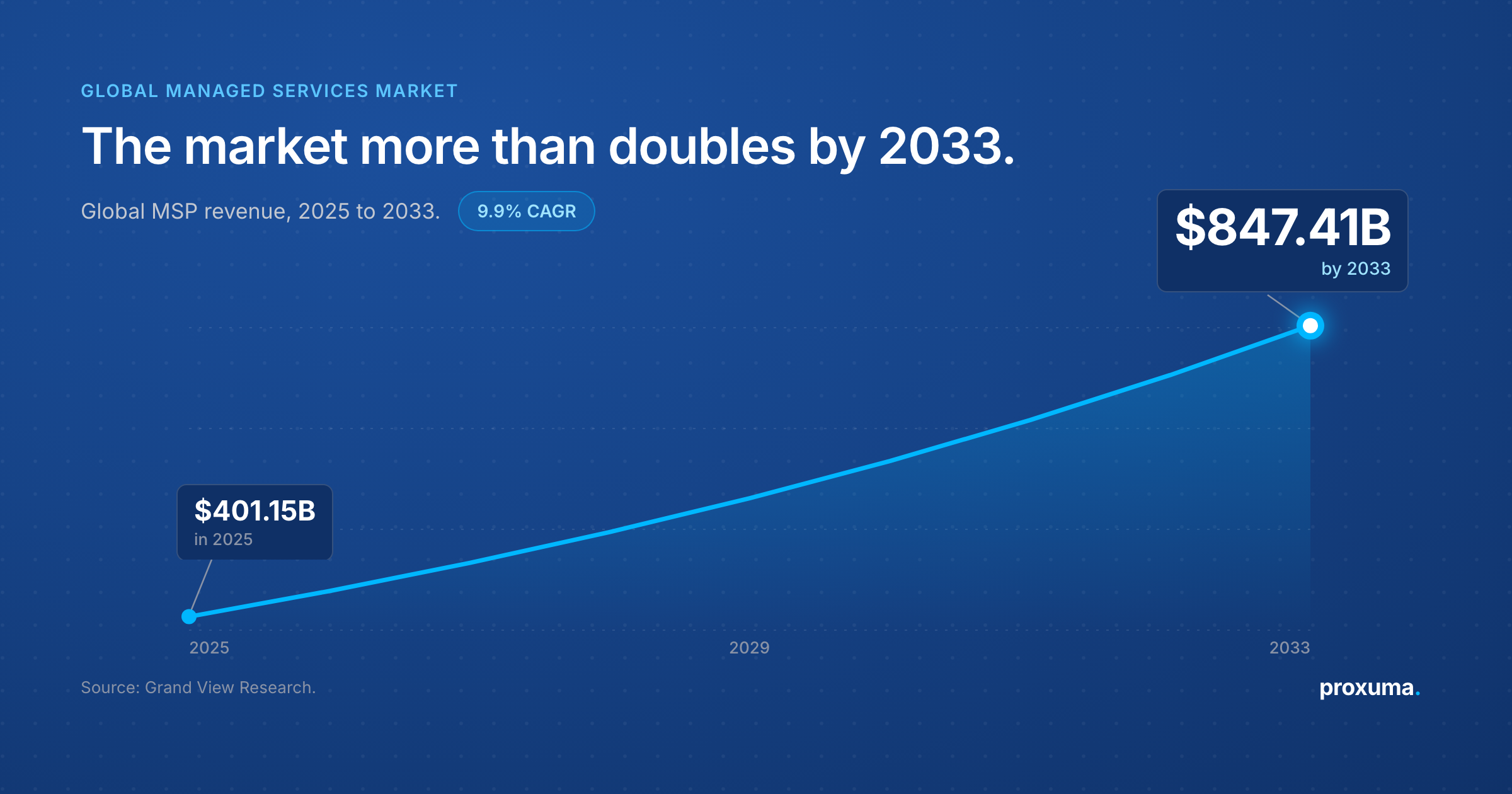
First, the numbers. The global managed services market reached $401.15 billion in 2025 and is on a 9.9% annual trajectory toward $847.41 billion by 2033 (Grand View Research). Nearly a doubling, driven by organizations offloading IT complexity, security becoming mandatory, and cloud that keeps expanding.
But you will not capture that growth the classic way, by hiring more people. The market for engineers has run dry, and your best people are already at their ceiling. Whoever wants the doubling has to do more with the people they already have.
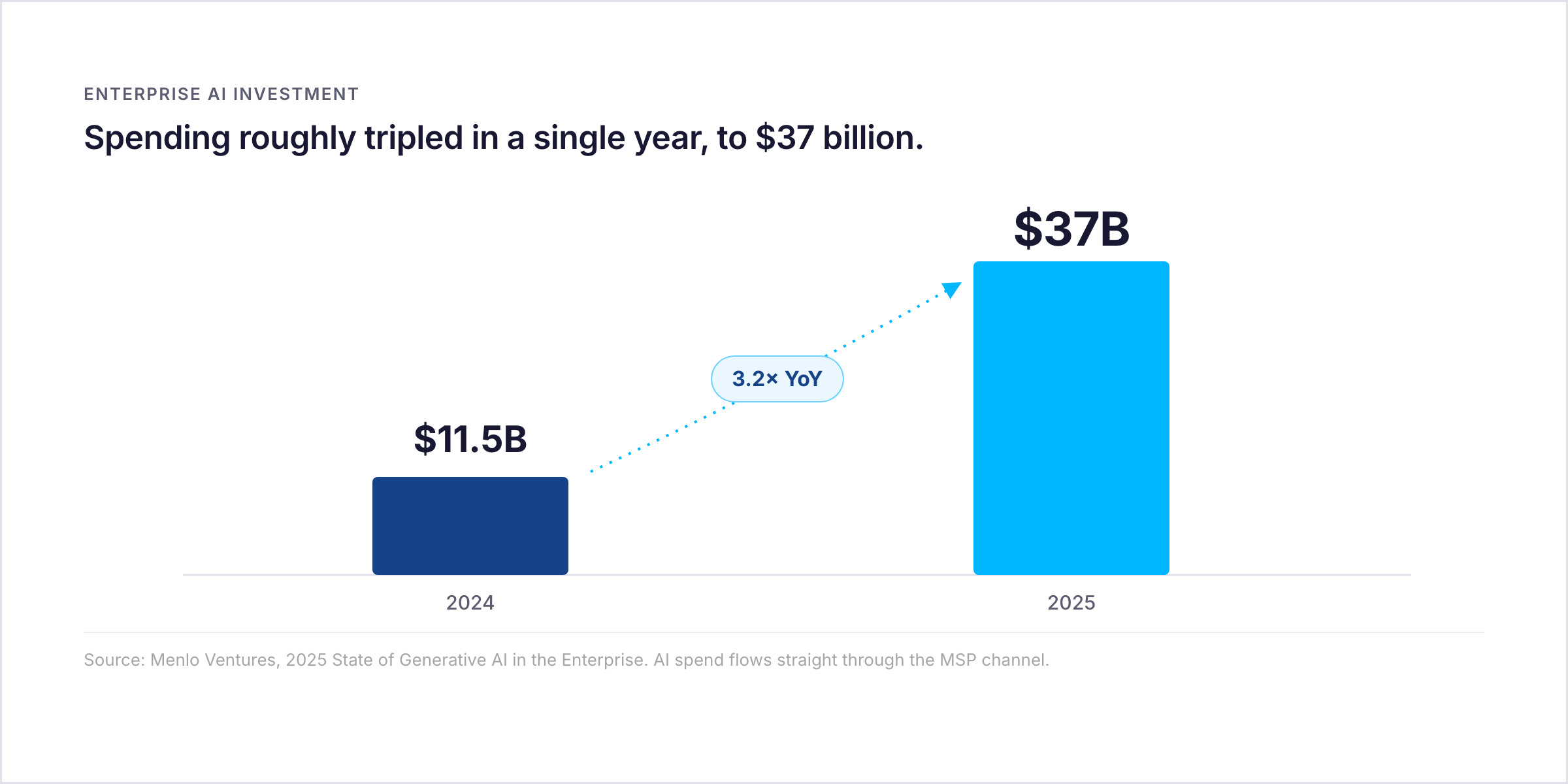
That is exactly what AI promises, and demand pushes in the same direction: organizations are turning to their MSP to deploy, secure, and operate it. You see it in the numbers: enterprise AI investment tripled in a single year to $37 billion (Menlo Ventures), and that money flows straight through the MSP channel. It cuts both ways, though: the MSP that cannot demonstrate AI fluency gets shut out of the highest-value contracts.
So the entire channel is running in the same direction. Agentic AI dominates every keynote and every vendor roadmap, and the message is the same everywhere. Buy AI, or miss the boat.
Most of that AI will not pay off
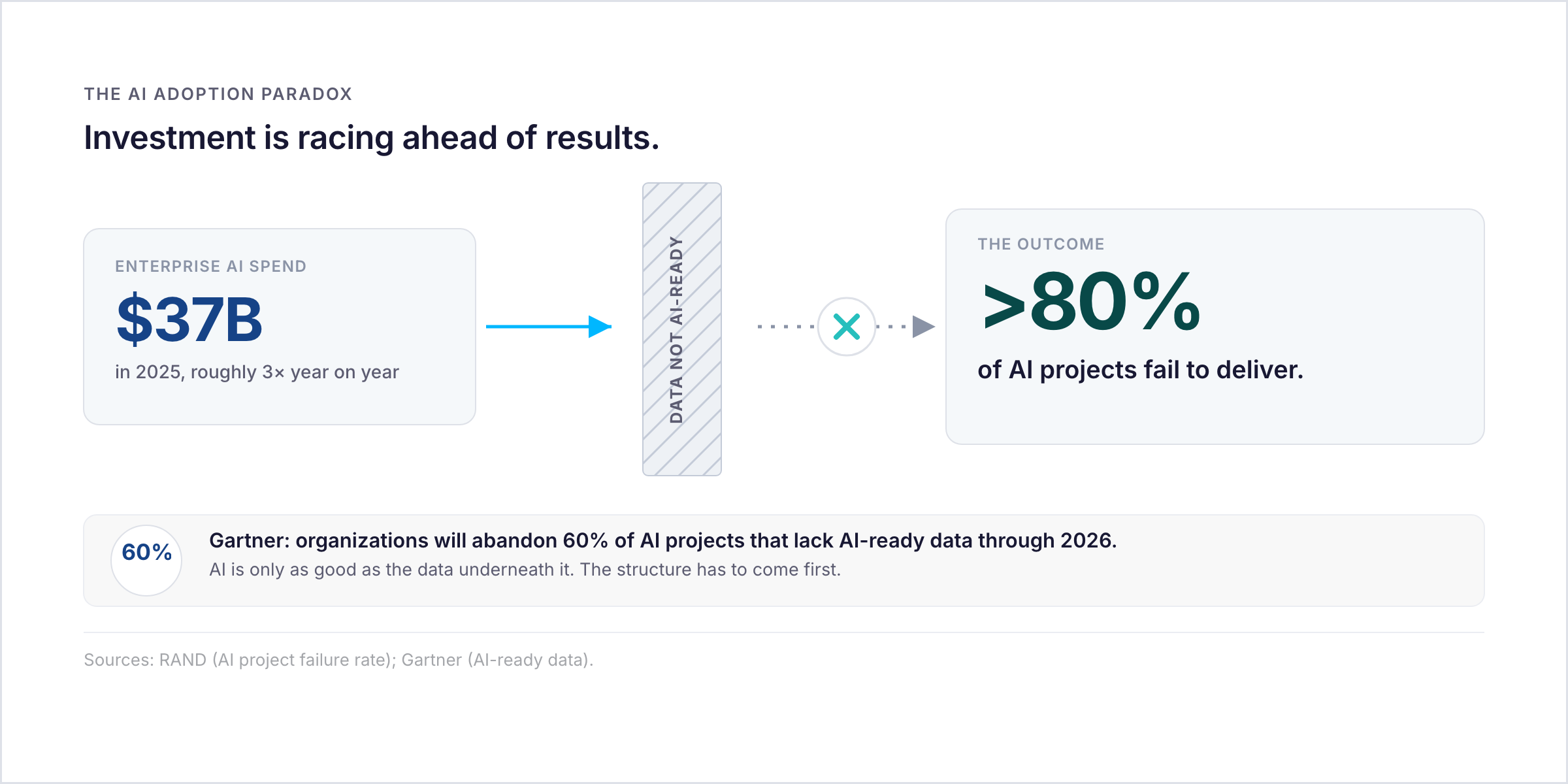
And the reason has nothing to do with the AI. Independent research finds that more than 80% of AI projects fail (RAND), and the cause is rarely the model. It is the data underneath it.
An agent, an assistant, or a copilot can only act on the records it is given. In most MSPs, those records are scattered across Autotask, the RMM, billing, and a dozen other systems. Entered inconsistently, never reconciled into one picture.
Point modern AI at that collection and you get the oldest result in computing: garbage in, garbage out. Only now at machine speed, with a confidence you will act on.
AI thinks. Automation acts. But data decides.
Autotask records the work, but shows you nothing
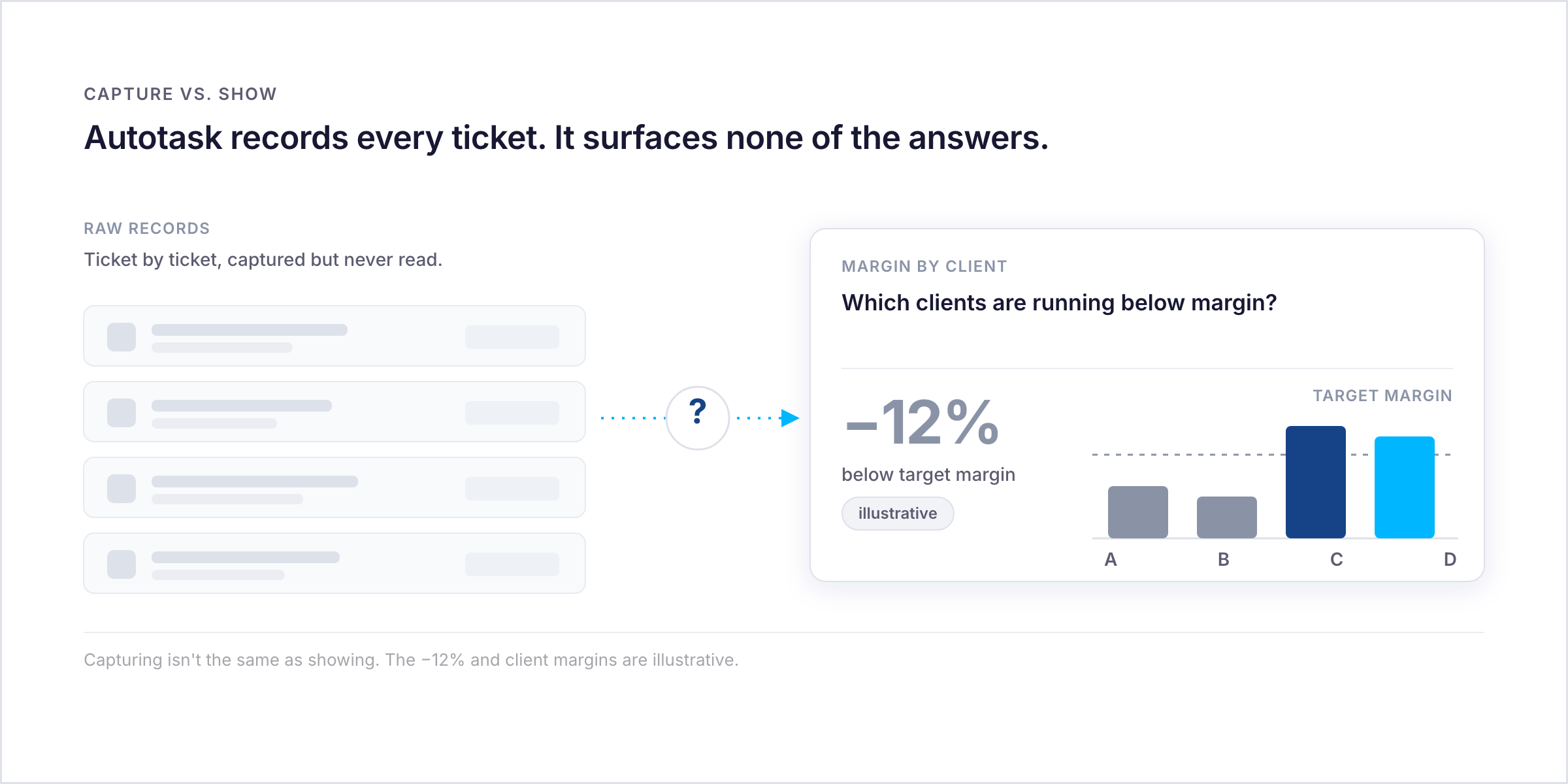
Autotask is one of the most widely deployed PSAs in the channel for good reason: it captures what an MSP does, ticket by ticket. What it does not do is turn that captured work into a picture you can steer on.
The data to run a better business already exists inside your tools. But it lives in spreadsheets next to the PSA, in the heads of whoever knows the shift rotation, and in board reports assembled by hand hours before the client call.
Cooper Copilot, Autotask's native AI assistant, is a genuinely capable tool within its own environment. But it too can only be as good as the layer underneath. And that layer, clean and connected, is exactly what most MSPs have never had the time to build.
The problem is architecture, not technology
That distinction decides the solution. A technology problem you solve by buying something new. An architecture problem you solve by connecting what you already have.
Concretely: one layer where Autotask, your RMM, your billing, and the rest come together into one model, where the same client, the same contract, and the same engineer mean the same thing in every measure. That is operational intelligence. Only once that layer exists does every euro you put into AI have something to stand on.
Built by people who do the work themselves
This is what Proxuma was built for, and how it was built makes the difference. Proxuma comes from Dxfferent, a team of MSP and Autotask specialists who advise and support MSPs every day, strategically and technically.
It was not designed in a vacuum: every capability traces back to a real question from a real MSP. Software for MSPs, with MSPs. And it is a platform, not a single-PSA tool: Autotask is the first and deepest integration, and the architecture is designed to extend.
The test you can run today
Ask your copilot or your dashboard one real operational question: "which clients ran below margin last quarter?" If you get an answer in seconds that you would put in front of your board, your data is ready.
If you first have to verify the answer by hand across three systems? Then your data is the problem, not your AI. And no new model will fix that for you.
Five checks on your data, three tests on your AI
Want to know exactly where you stand? Five places in your own Autotask, no extra tooling required.
1Issue and sub-issue types. Admin > Features & Settings > Service Desk (Tickets) > Issue & Sub-Issue Types. Pull ten password-reset tickets and count the combinations. More than two, and your reporting is counting apples and oranges. And any AI model running on it learns noise as pattern.
2Work types on time entries. It is the time entry, not the ticket, that decides what falls under contract and what lands on the invoice; the ticket's work type is silently inherited at booking time. Count how many of this week's time entries were never consciously chosen: those hours were billed on autopilot.
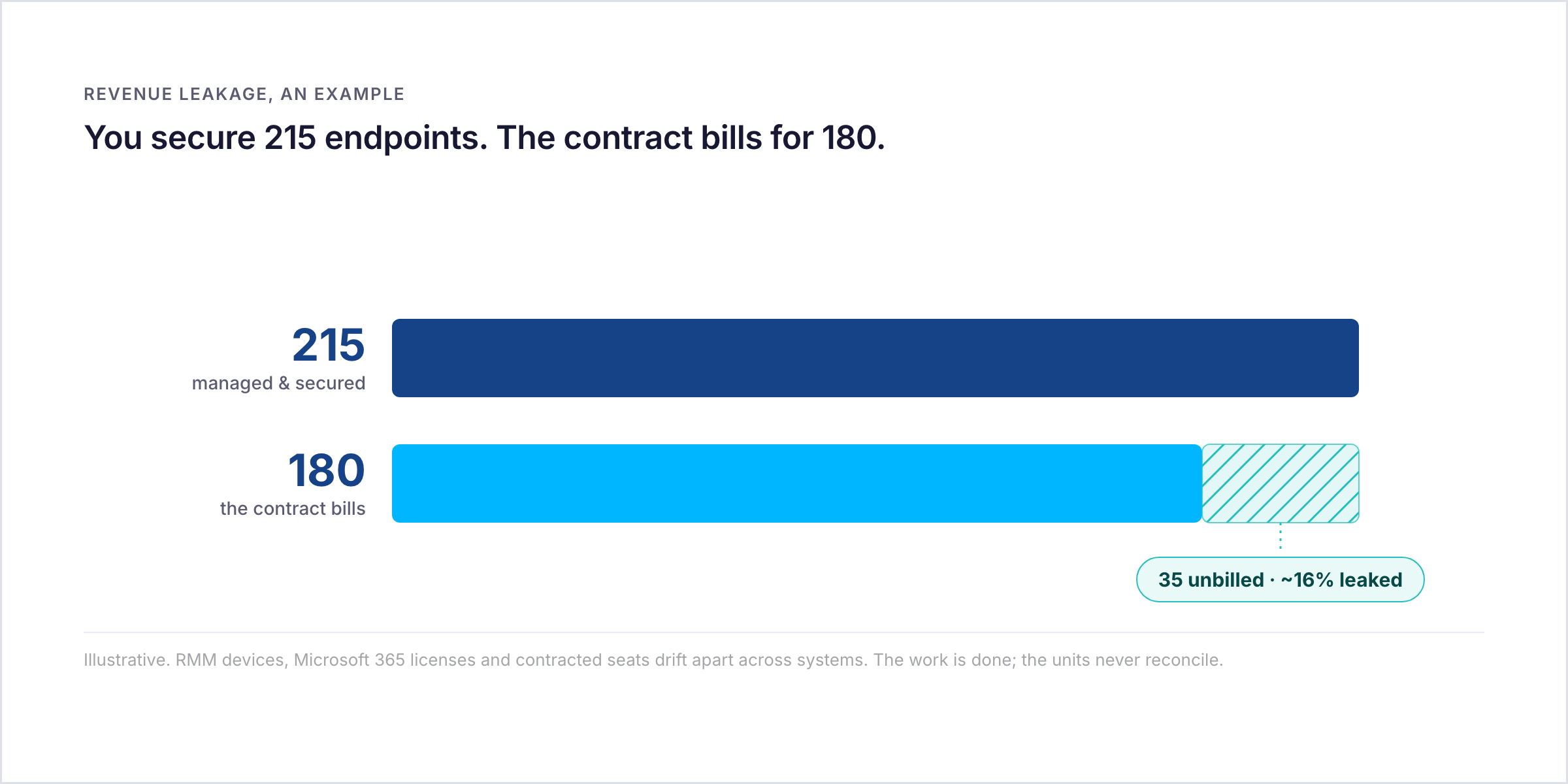
3Contract quantities. Put your RMM count next to the services on the contract. 215 endpoints managed, 180 on the contract: both numbers are correct in their own system. The real questions are which number is true, who bills the difference, and when this was last updated.
4Hours. Worked versus available, per engineer. Billable or non-billable, approved or stuck? Whatever lingers here is missing from your utilization, your margin, and your Approve & Post batch.
5Profitability measured twice. Put per-client profit from your accounting system next to what Autotask says. If they diverge per client, ledger, or contract, something is off: costs booked nowhere, hours outside the contract, or a link that does not reconcile.
And whether your AI can be trusted on that data shows in three five-minute tests. Ask the same question twice, phrased differently: two different numbers means it is guessing. Ask which records sit underneath each number: not traceable means not steerable. And ask something your data cannot possibly know. Good AI says "I can't see that". Bad AI fluently invents a number.
People stay at the core of this story. Your engineers are the scarcest, most expensive asset you have; AI and automation multiply what they can do, they do not replace them. But a multiplier on quicksand just sinks faster. The MSPs that capture the doubling will not be the ones that bought the most AI. They will be the ones whose data was ready for it, before the competition got theirs in order.
Is your Autotask AI-ready, or are you about to put AI on data you do not trust?
Proxuma is not another AI tool. It is the operational intelligence layer that turns Autotask and 12+ connected systems into one reliable, AI-ready foundation, with 500+ pre-built measures on top. Read the whitepaper "The Intelligent MSP" or book a 30-minute demo. Live within 24 hours, and you keep your PSA.
// The Intelligent MSP · 2026 white paper
AI rewards the MSPs that got their data right first.
Our 2026 white paper on why most AI projects fail on bad data, what separates best-in-class MSP margins from the median, and how to turn Autotask into an AI-ready foundation, before the competition does.
$401B $847B market by 2033 80%+ of AI projects fail on data 95% say integration blocks AI
Read the full whitepaper