The Engineer Hour Rate: the profit compass most MSPs are missing
Blogs
You quote a number. Ninety-five euros an hour, give or take. But ask a harder one: what does a single engineer hour actually cost you to deliver? Most MSPs cannot answer that, and the gap between the rate you quote and the rate you need is exactly where the margin quietly goes.
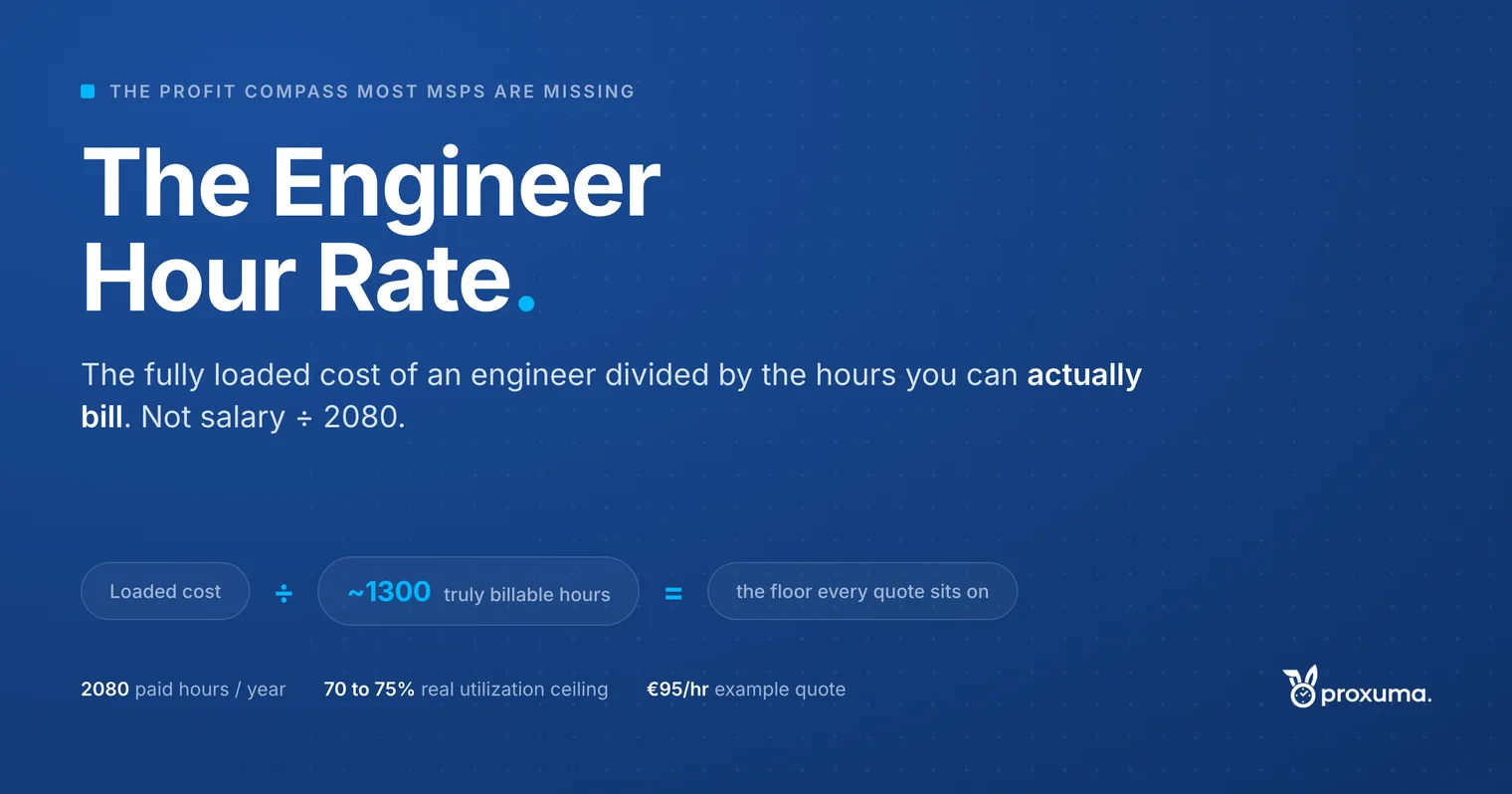
That number has a name. The Engineer Hour Rate is not salary divided by 2080. It is the fully loaded cost of an engineer, salary plus employer taxes, tooling, training, management and office, divided by the hours you can actually bill. Both inputs surprise people: the cost is higher than the salary, and the billable hours are far lower than the paid hours.
The utilization multiplier
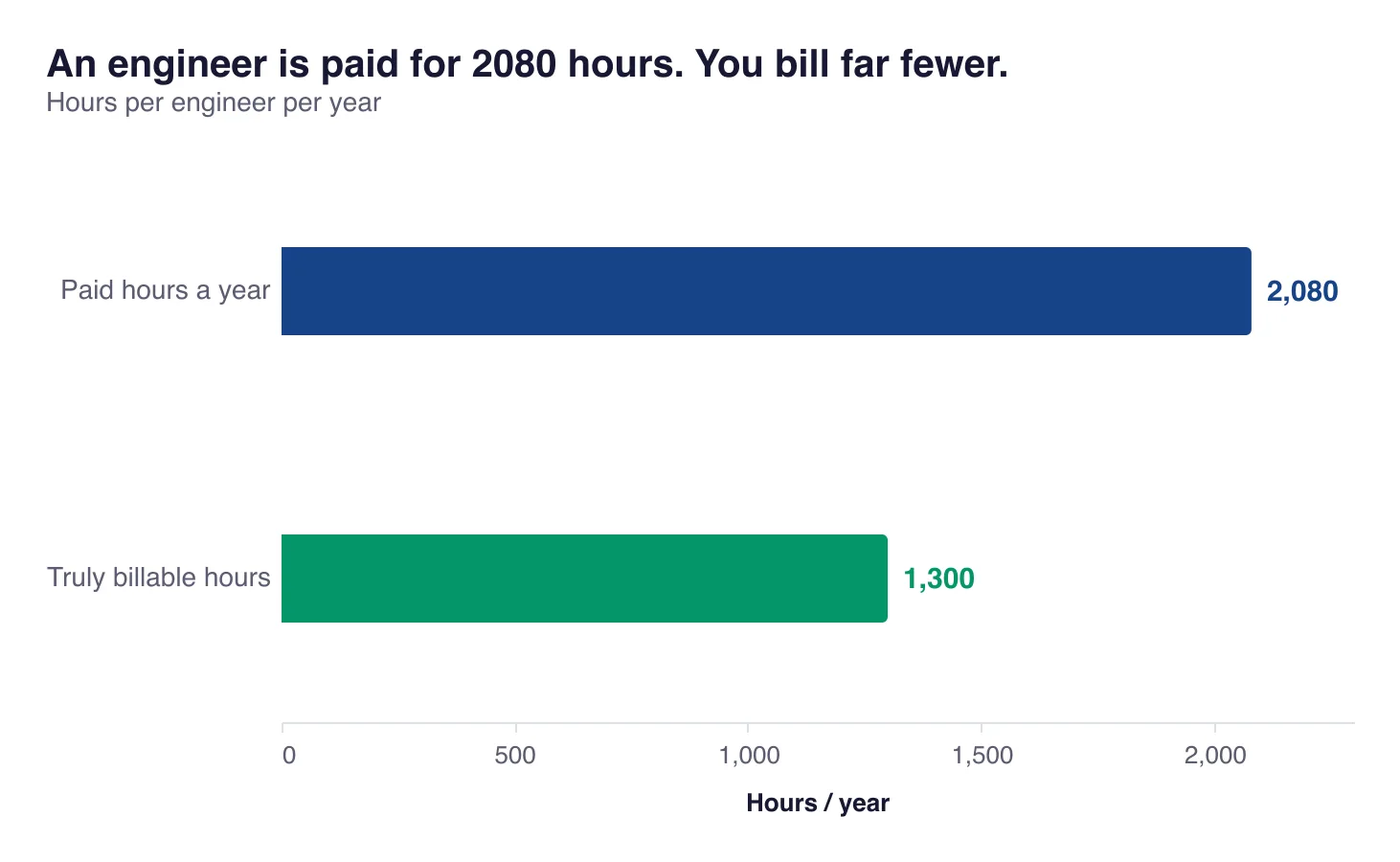
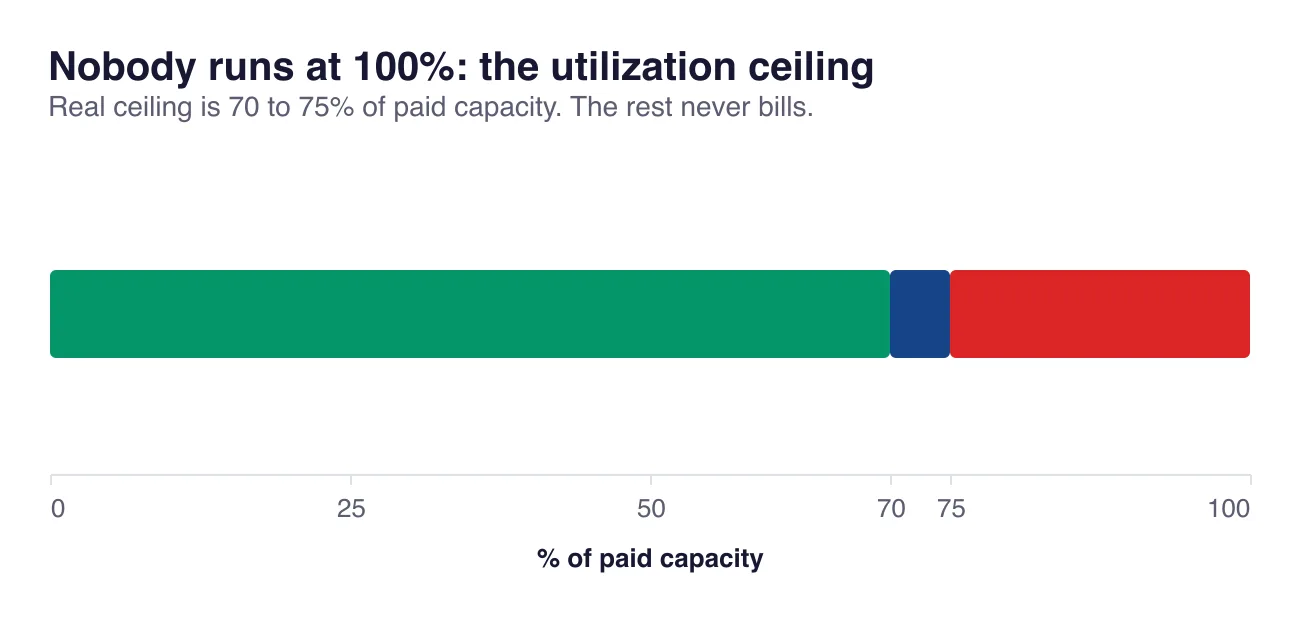
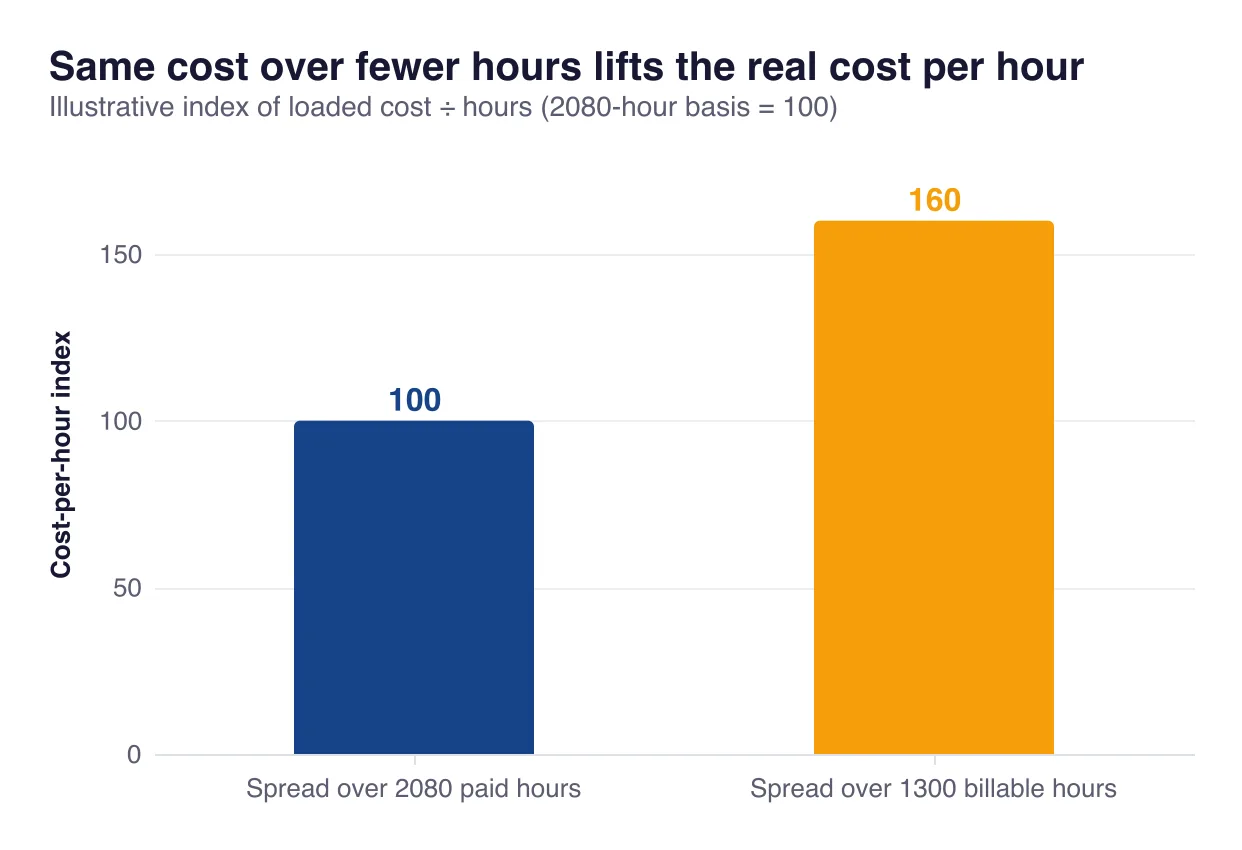
An engineer is paid for about 2080 hours a year. You do not bill 2080. Subtract holiday, sick days, training, internal work and admin, then add the simple fact that nobody runs at 100%. Most MSPs hit a real utilization ceiling around 70 to 75%, and after the non-billable slice the truly billable hours often land closer to 1300. Spread the loaded cost over 1300 hours instead of 2080 and the real cost per billable hour jumps well above the naive figure. That number, not your salary math, is the floor every quote sits on.
Paid for 2080 hours, billable for closer to 1300.
Why most MSPs never see it
Two habits keep the rate hidden. Pricing gets set against the market or on gut feel, not against the cost of delivery. And MSPs track revenue per engineer, which always looks healthy, instead of margin per engineer, which is where the truth lives. Without the rate there is no reference line, so a contract priced five euros under cost looks identical to one priced fifty euros over. Both just say "billable".
The real utilization ceiling sits around 70 to 75 percent.
The compass
Once you know your Engineer Hour Rate, every quote, every contract and every ticket has a reference point. You can see which work sits above the line and earns, and which sits just below it and bleeds. Pricing stops being a feeling and becomes a decision. "Are we busy" becomes "are we busy on the right work".
Why it gets more expensive as you grow
A contract priced below your Engineer Hour Rate does not lose money once. It loses money every hour, for the life of the contract. Scale a book of work without knowing your rate and you scale the underpriced contracts at the same speed as the good ones. The market is doubling. Doubling work you priced below cost does not double profit, it doubles the loss.
Cost per billable hour climbs as you scale (index, illustrative).
And you cannot fix it by hiring. More engineers at the same low utilization just multiply the same thin rate. You lower your Engineer Hour Rate by moving utilization toward the ceiling and by adding leverage, and both start with being able to see the number.
From gut-feel to data
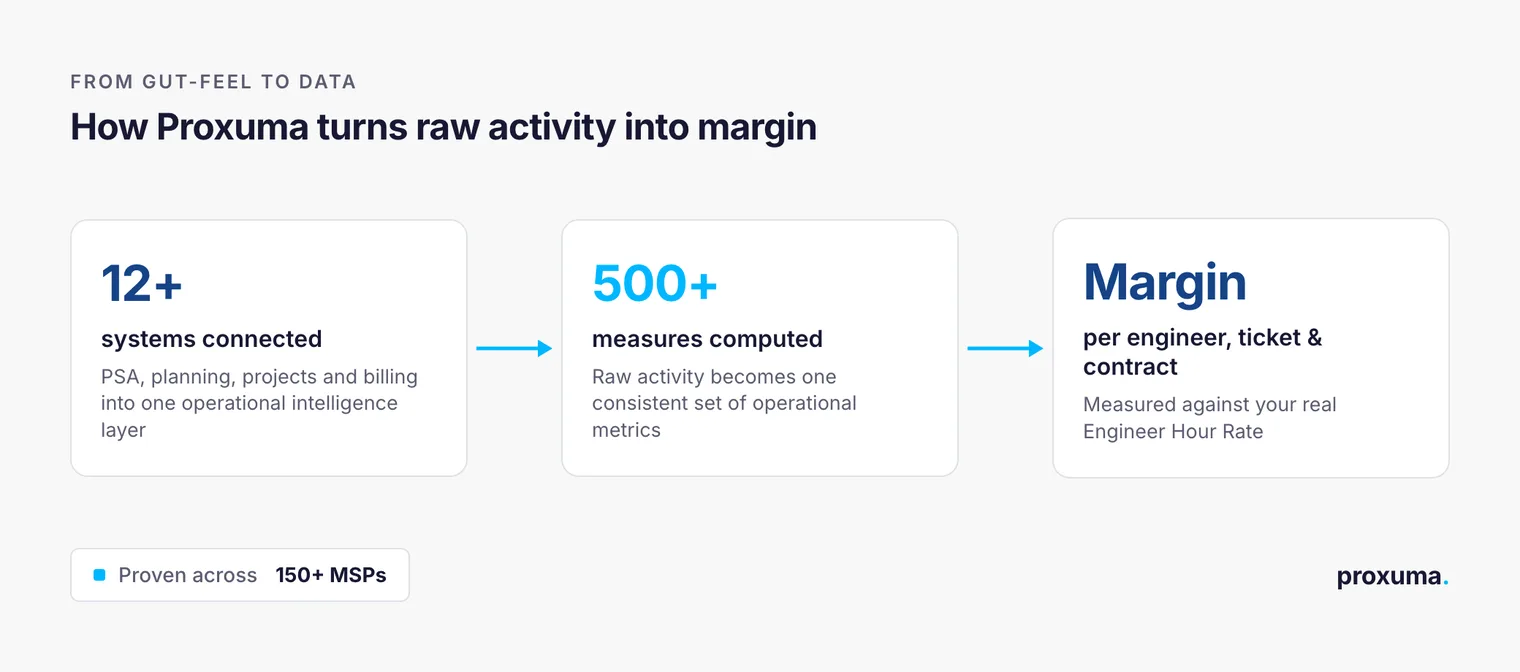
This is what Proxuma puts on the screen. It connects 12+ systems across PSA, planning, projects and billing into one operational intelligence layer, turns the raw activity into 500+ measures, and computes margin per engineer, per ticket and per contract against your real Engineer Hour Rate. Across 150+ MSPs the first look is almost always the same: the rate they thought they were earning and the rate they were actually earning are two different numbers.
From 12+ systems to 500+ measures to margin per engineer, ticket and contract.
Your PSA records the work. Proxuma understands your operation.
Do you know your floor, or are you pricing against someone else's guess?
The MSPs that turn the doubling market into profit will be the ones who price against their own rate, not the market's mood. Read the whitepaper "The Intelligent MSP", or see your real Engineer Hour Rate in a 30-minute demo. Live within 24 hours, and you keep your PSA.
// The Intelligent MSP · 2026 white paper
AI rewards the MSPs that got their data right first.
Our 2026 white paper on why most AI projects fail on bad data, what separates best-in-class MSP margins from the median, and how to turn Autotask into an AI-ready foundation, before the competition does.
✓$401B → $847B market by 2033✓80%+ of AI projects fail on data✓95% say integration blocks AI